Sunday, September 18, 2011

Algonquin Trip - More Pictures and a Gear Report

Otterslide Lake Sunset

More Pictures

Now that I've been home for awhile, I've had a chance to go through the rest of the pictures from my canoe trip. While I think the best pictures were in my earlier blog entry, there are certainly some good pictures that didn't make it into my blog entry. You can find these in my Picasa album.

Equipment and Food

The planning for our trip was guided by two principles - single-trip portages and no washing of dishes.

My years of backpacking have taught me not to bring anything I don't need. We packed relatively light, but not overly so. We used two packs - one primarily for food and the other for gear. All of the portages were single-carry. My son, Calvin, carried the gear pack, PFDs and paddles. I carried the canoe and food pack. I'd estimate the gear pack weighed 50 lbs and the starting weight for the food pack was 40 lbs. I would typically start each day with two liters of water, which I would carry in the food pack.

We used a Wenonah Jensen 17 canoe for this trip. This is an easy-handling, fast-moving canoe. Best of all, it weighs about 45 lbs and is nicely balanced over the yoke, making it easier to carry.

Equipment List
Clothing

With proper layering, we were able to keep our clothing to a minimum. This was further reduced by knowing that we rarely use the clean clothes that we bring. For each of us, we brought:
  • A pair of convertible pants (shorts and long pants in one garment)
  • Single change of shirt, underwear and socks
  • Rain gear (jacket and pants)
  • Marmot Windshirt (unused due to the warm temperatures)
  • Vest
  • Long-sleeve Capilene 1 shirt
  • Lightweight running shorts (for swimming)
  • Salomon Techamphibian water shoes (worn while traveling)
  • Sandals for camp
Food

The only cooking our meals required was boiling water, which we did on the Jetboil stove. Nearly all of the food was purchased at the local grocery store and was prepared in freezer bags. We also ate from the freezer bags, which was why Calvin was longing to eat from a real plate. This approach minimizes the cooking equipment required and eliminates the need to wash dishes.

For lunch, we had gouda cheese and pepperoni (or summer sausage) on flour tortillas. We also brought three apples. We would share one apple every other day and an apple had never tasted so good. In addition to our meals, we brought enough other food (trail mix, dried fruit, beef jerky, cookies, etc) that we never felt like we were doing without.

Dinners consisted of a variety of ramen noodle dishes, couscous and instant mashed potatoes. When meals called for chicken or vegetables, we used AlpineAire freeze-dried chicken and AlpineAire freeze-dried vegetables. Some meals called for bacon and we used Oscar Mayer real bacon bits.

In addition to the instant coffee and hot chocolate mix, we brought plenty of Kool-Aid mix to drink.

To keep the critters out of our food, everything was kept in OPSAK odor-proof barrier bags. We had used these before and they seem to work well, though probably not for bears.
 
Breakfast
  • Instant oatmeal (two packages per person, per day)
  • Starbucks VIA coffee
  • Hot chocolate mix
  • Nature Valley Granola bars (brought 20, also used for trail food)
Lunch
  • Three 10 oz wheels of Gouda cheese (2.5 oz per person, per day)
  • Pepperoni
  • 8 oz Summer Sausage
  • 30 flour tortillas
  • 3 apples
Dinners
Snacks
  • cookies
  • trail mix
  • dried pineapple
  • sunflower seeds
  • beef jerky
  • marshmallows

Sunday, August 28, 2011

2011 Algonquin Provincial Park


The beauty of Algonquin Park
For the second consecutive year, I enjoyed a week of canoe camping with my 16 year old son Calvin. We returned to the same general area as our previous trip, but our route would take us to places I've never been to before.

In order to  to allow others to follow my progress and to provide my spouse some piece of mind, I brought along a SPOT Satellite GPS Messenger. You can see how our trip went by clicking on the following link: Algonquin 2011 - Spot Adventure

Day 1 - Magnetawan Lake to Queer Lake
Nighttime approaches
With a planned late arrival at the access point, we quickly loaded up the canoe and headed out. Two hours later, we were setting up camp. We collected firewood, filtered water and cooked dinner before nightfall.

Day 2 - Queer Lake to Shippagew Lake via Tim River
This was planned to be a long day. Even so, the day was longer than expected. The Tim River has a reputation for being twisty and slow.

Discouraging, but accurate, commentary
The day began with a 1330 meter portage. In Algonquin, each portage is marked with a yellow sign indicating the body of water on each end, along with the length of the portage. The sign for this portage also had some editorial comment, which had Calvin saying, "That doesn't sound promising." Unfortunately, the commentary was right on the money.

Starting from the Queer Lake portage, there were two beaver dams right away. The second one had effectively choked off the water beyond it and we found ourselves doing a lot of wading. The river bottom in this section was mostly sandy, so it wasn't miserable, but it was slow. After this point, water levels weren't much an issue.

The twists and turns made for some slow paddling, which I expected. What I neglected to consider was how slow the travel would be in the "straighter" sections of the river. There were a lot of weeds, which also made for slow going. It took an effort just to get the paddles into the water.

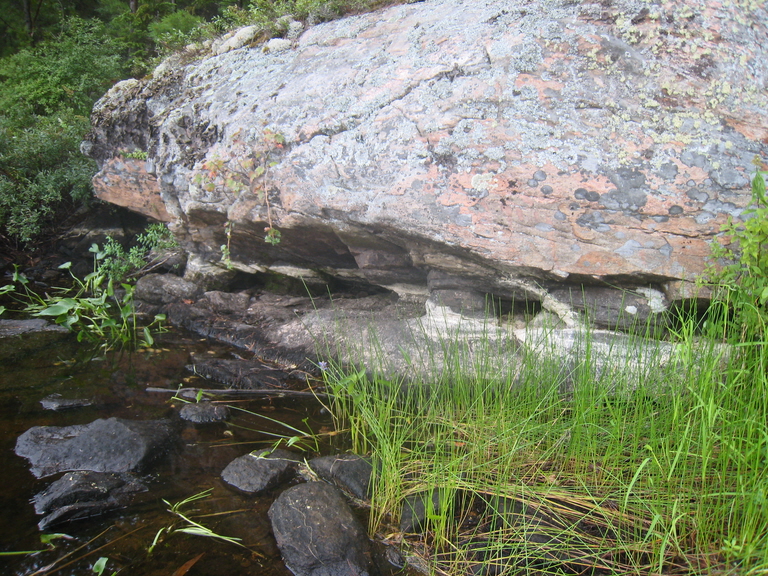
Shoreline erosion at our Shippagew Lake campsite
After seven long hours, we arrived at our campsite on Shippagew Lake. As we set up the tent, it started to rain a bit. Thankfully, the rain was brief and we had an enjoyable night sitting around the campfire.

For the day, we only saw one other canoe and they were bailing out on a day trip to the first campsite past the portage from Queer Lake after they saw the really low water. We had Shippagew to ourselves.

Despite the difficulty, I enjoyed paddling the Tim River. We saw a bull moose and more great blue herons than we could count.

Day 3 - Shippagew Lake to Burntroot Lake
The day started when I was awoken by an incoming thunderstorm at 6:00 AM. In the east, I could see a brilliant red/orange sunrise. In the west, the skies were dark with flashes of lightning. I quickly double-checked to make sure everything was secure and went back to sleep.

When I crawled out of the tent two hours later, it was a bright sunny day. I spent the rest of the morning lounging in the sun, reading a book as Calvin continued his slumber. After breakfast, we broke camp and headed out for a relatively short day. We quickly realized that we were still feeling the after effects of the previous day.

A short paddle brought us to our first portage, which turned out to be a 1460m beast. The trail was rugged and hilly. There were long sections where you had to walk across moss-covered rocks to get over some swampy areas. With the morning rain, everything was very slick, especially those rocks.

Checking out some suspicious-looking paddlers
After surviving the portage, we started paddling up the aptly named Longer Lake. The upper part of this lake narrows dramatically into a grassy, marshy area before flowing into a river. This is one of my favorite areas in the park.

As we made our way through the channel in the marsh, Calvin spotted a moose. I quickly grabbed my camera and we moved closer to get some pictures. For a long period of time, this large bull moose munched away on the plants, occasionally glancing our way to make certain we were no threat.

We left the moose to enjoy his lunch and continued to the shortest portage of our trip - 40 meters around an impassible set of rapids. We enjoyed some raspberries, which Calvin discovered, and continued on to Burntroot Lake.

Burntroot Sunset
We chose to stay at a nice island campsite, the same one we used last year. After setting up camp, we settled into our normal routine - playing Gin and Mille Bornes. As nighttime approached, I enjoyed the sunset while Calvin scoured the shoreline searching for frogs. 

Day 4 - Rest Day on Burntroot Lake
As usual, I awoke early while Calvin slept. Immediately after making my coffee, I set up my hammock in the morning sun and spent the morning alternately reading, napping and sipping on coffee. It was heaven.

Root cellar on Burntroot Lake
Since this was a rest day, we planned to do a little bit of exploring. On last year's trip, we went to the top end  of the lake where the map indicated that there was a root cellar. After searching for half an hour, we couldn't find it. We vowed to be successful this year, even if it took all day.

We put ashore and started our search. After a grueling 30-second search, we found the root cellar, stunned at our ineptitude of the year before.

After returning to our campsite, we rested up for what was planned to be our longest day of the trip.

Day 5 - Burntroot Lake to Otterslide Lake
This day started like the previous day - I was relaxing in my hammock as Calvin slept. There were more clouds in the sky, so it wasn't quite as warm. Since we had a long day ahead of us, I woke Calvin up early at 9:30.

While packing up, we noticed that the western skies were darkening. We loaded up the canoe and pushed off with lightning and obvious rain in the distance. We were traveling south toward brighter skies, so we were optimistic. Our optimism turned into misery in just ten minutes. The rain started falling hard and the lightning and thunder turned more ominous. Before long, we pulled ashore to wait out the worst of it.

Although we were soaked, I pulled out the rain jackets to make sure we stayed warm enough. After the worst of the lightning had passed, we resumed our journey. We made it five minutes before it started raining even harder than before. Silently, we paddled on.

A mother and her offspring
At one of the first portages, we again waited out the lightning and heavy rain. Calvin was very quiet and miserable. With the rain letting up, we began our paddle down Longer Lake. Within minutes, heavy rain started again and Longer Lake never seemed so long.

At the next portage, we encountered a father and son standing under the trees. They looked like we felt. Trying to lighten the mood, I asked if it was drier on the other side of the portage. The father laughed and the son continued looking miserable.

Next, something amazing happened. It actually was drier on the other side of the portage. The skies had turned much brighter and the rest of the day was dry. Our miserable day had turned around.

Later in the day, as we were loading the canoe after a portage, Calvin spotted another moose. This one was a cow and was wading in the water nearby. We quietly watched when suddenly Calvin spotted a second moose - this one a calf. It was amazing how our day had turned around.

It wasn't to last, though. After eating, the skies grew dark again and we were chased to our tent for the rest of the night.

Day 6 - Otterslide Lake to Tom Thomson Lake
It rained most of the night, but thankfully, it stopped by morning. The skies were still gray and ominous, which put a damper on our mood. Our spirits didn't brighten as it started to rain in our first hour of paddling. The rain didn't last long and we paddled happily under overcast skies.

Gray skies on Otterslide Lake
We stopped at an island campsite on Burnt Island Lake for lunch. While we were there, the skies cleared and we had a wonderful lunch sitting in the sun on a large rock. It made us forget about the foul weather we had endured. Fortunately, we couldn't see the western skies or it would have put a damper on our enjoyment.

After lunch, the winds were starting to kick up and we had to work much harder to make progress. Our campsite on Tom Thomson was on the tip of a peninsula, but was nicely sheltered from the wind. It was dry while we set up camp, but it wasn't long before the rain started again. There were some tall pine trees over the campfire ring, so were sheltered from much of the rain. Eventually, though, we were chased into our tent again without a campfire.

Although we ended up with a good day, it wasn't without its disappointments. Being somewhat close to the Highway 60 Corridor, we were traveling over some of the most heavily used sections of the park. We saw more people on this day than we had up to this point. We also saw signs of the heavy use. At the first portage, I picked up more garbage than we had accumulated ourselves. It was appalling to see. On other portages, I saw more garbage. At the campsite on Tom Thomson, it was even worse. I picked up a dozen zip ties that people had used and just left on the ground when they left. Trees were hacked with hatchets and stripped of their bark. When looking for firewood, we came across a pile of garbage that included styrofoam cups. It was depressing and I probably won't ever travel to this section of the park again.

Day 7 - Tom Thomson Lake to Magnetawan Lake
A welcome sight - clear skies
After two days of rain, we had decided the night before that we'd make a push for the car. This meant that we would need to combine two days of travel into one. It would be a challenge since it meant 18 miles of travel with ten portages covering 3.5 miles. We were confident we could do it even though the furthest we had traveled in a day was 14 miles. If we were on the water by 8:00, I thought we could make the car by 2:00.

Even though it had rained most of the night, we awoke to clear skies. We packed up and were on the water by 8:30. Unlike the rest of the trip, the winds were blowing strong and were in a direction that meant we'd be paddling into the wind for most of the day.

Amazing view on Timberwolf Lake
After tackling a difficult 2400 meter portage, we arrived on Ink Lake. This is a small lake surrounded by marshes. It wasn't long before we discovered the origin of the name. The water was so dark with tannin, you could barely see your paddle in the water. Calvin described it as paddling in red wine.

At one portage, Calvin refused to get out of the canoe. He said there was a giant spider. I couldn't see it, so I assumed he was exaggerating. Once I saw it, I realized that he wasn't. This thing was about three inches across. I moved the canoe to a different spot so Calvin could disembark.

After our third portage and fourth lake, Calvin asked me if we were at least making good time. I felt we were, but it was hard to know for certain. We still had a long way to go, including a river that would have a number of beaver dams. We pressed on, determined "to have dinner on a plate," as Calvin said

On the river, we encountered a couple of beaver dams. We had seen many on this trip and were experts at getting our canoe over them. The second one was very tall with about a 2-3 foot drop. As we were crossing this one, we saw a beaver. With all the evidence of beaver activity, this was the first one we'd seen on our trip.

Looking back at Misty Lake
After our river travel, we were tiring somewhat, but we were in the home stretch. At one of the last portages, after I hoisted the canoe onto my shoulders, Calvin gave me a single blueberry, which he had found. I said with a laugh, "Thanks, that will get me to finish line."

Before long, we were paddling across the last lake and arrived at the car at 2:30. With the glorious weather we had enjoyed all day, it felt like a mistake to cut our trip a day short. That thought was quickly washed away as a downpour started as we carried the canoe back to the car. We loaded up the car and started the long drive home.

It was another successful trip. We had some good times and some miserable ones. It will be a lifelong memory.

Since writing this bog entry, I've written a related entry, which has more pictures and a complete equipment list.

Friday, July 15, 2011

Full Speed Ahead

It's been just over a month since my hospitalization. At the time, I was certain that I would be forced to take an extended break from paddling and biking. Thankfully, I've been proven wrong.

After just ten days, I started paddling again - slow and easy, at first. Over time, I paddled harder and longer leading up to my first race on July 4, which I did with my son. I've since competed in two more races and I felt nearly as strong as I did in May.

After three weeks, I started biking to work again. It felt great to be on the bike again, but the fitness I was accustomed to was missing. I didn't care - that would return with time. I felt better each time I biked to work and last weekend I enjoyed a 50-mile ride with some friends.

The final hurdle was getting back on the mountain bike. Bumps and bruises and cuts and scrapes go with the territory when you're mountain biking. Being on blood thinners, this was as much a mental hurdle as it was physical. This week, I pushed the mental part aside and was reminded how much I enjoy mountain biking.

At this point, I'm just about back to where I want to be. Sure, I'm still spending too much time at the doctor, but this is just a distraction. I choose to move forward at full speed.

Monday, June 13, 2011

Feeling Fortunate

In the midst of my best competitive paddling season ever, I was delivered a shock.

I've been racing canoes for 10 years and the focus of the spring has always been the General Clinton Canoe Regatta. This is a 70-mile race on Memorial Day, which starts in Cooperstown, NY. It takes long hours of training to prepare for this race. The race itself usually lasts longer than eight hours.

After a full week of recovery time, I decided it was time to step up the training again. Rather than ease into it, I chose to do some interval training. For those unfamiliar, this is a series of hard efforts separated by short periods of rest.

By Monday evening, I felt some soreness in my abdomen - most likely a result of the intervals following a week off. Sleeping was difficult Monday night. My ribs would hurt no matter how I was lying in bed. Upon waking on Tuesday, I took some ibuprofen, which took care of the rib pain.

Throughout Tuesday the abdominal and rib pain had spread to my back. At times this pain was acute, but mostly it was a dull ache. Still, there was nothing to indicate that it was anything other than muscle soreness from the intervals the day before.

On Wednesday morning, I noticed some chest congestion and shortness of breath to accompany the pain. Looking online, my symptoms seemed to indicate that I had somehow contracted pneumonia. I made an appointment with my doctor for Thursday morning.

I left my Thursday doctor visit with a diagnosis of abdominal muscle strain. It didn't seem right to me, but the chest x-rays didn't show anything in my lungs. I was prescribed an anti-inflammatory was told that the pain should subside within a few more days. I was skeptical, but I didn't have anything to point to that could show the diagnosis was incorrect.

Despite taking the prescribed anti-inflammatory, the pain on Thursday was the worst yet. As the day progressed, I decided that if the pain didn't subside by morning, I would call the doctor again. That never happened. Instead, my doctor called me late in the day to say that the radiologist spotted something suspicious on the x-rays. He wanted me to go for a CT scan right away to rule out the possibility of a pulmonary embolism, a blood clot in the lung.

The words "pulmonary embolism" certainly grabbed my attention. My mother has had a recent history of blood clots and I was fully aware of the risks involved. An undiagnosed and untreated pulmonary embolism can be fatal. As I drove to the hospital, I wondered how this could happen to me, someone who was very fit.

The CT scan confirmed the pulmonary embolism and I was admitted to the hospital. A series of doctors and nurses asked me all the standard questions - "Had I traveled recently?", "Any pain or swelling in your legs?", etc. None of the typical precursors seemed to apply to me.

After an overnight stay at the hospital, I was released with a full understanding of my prognosis and treatment. Yet, I still had many questions about how and why this happened to me. I've since learned of other paddlers who have suffered from pulmonary embolisms. In addition, some brief searching found a number of stories of endurance athletes that were similar to my own. None of these stories included suitable explanations.

I may never know the exact cause of my pulmonary embolism, but I do know this - I feel very fortunate.

Friday, December 3, 2010

Reflections on Bike Commuting

For the last few years, I've been a semi-regular bike commuter, opting to drive whenever it was too wet, too cold or I was just too tired. One year ago this week, I decided to commute to work exclusively by bicycle. I haven't driven to work since.

I've ridden when it was 5 degrees and when it was 100 degrees. I've ridden when it snowed and when it rained and I've ridden on days when I felt too tired. In the past year, I've ridden 3500 miles and spent 250 hours outdoors that I wouldn't have otherwise. It's been great.

Bike commuting puts me in a better frame of mind. It gives me plenty of time to think and enjoy my surroundings. I see the same people walking everyday - alone or, more often, with dogs. I see fathers fishing with their young children.

I've had turkeys, and a cow, cross the road in front of me. I ride past a pond where I see many turtles, who've dragged themselves onto the rocks to warm up after a cool night.

The seasons change with a subtlety that I didn't used to notice. One season lingers on just long enough to make it seem like the new season suddenly arrived.

The winter brings an earlier sunset and with it comes a different experience. I see deer staring at me as I ride by in the dark. There's a heron standing in the same spot almost every night. The Christmas decorations don't fly by as quickly - my favorite is the Abominable Snowman putting the star on a tree.

I'm looking forward to what the next year of bike commuting brings. I'll finish by relating a couple of stories from the last year.

A Successful Campaign

Last spring, I would see a guy every day who was running for a local elective office. Each day, rain or shine, he would stand with his campaign sign, waving and smiling at everyone who passed. This proved to be a successful strategy. After he won, he stood there one last day holding a sign that said "Thank You".

Faster Than a 4Runner

One day as I was riding home from work, I noticed a guy in a white Toyota 4Runner pass me. Normally, I wouldn't take note of this, but he took a long time to pass me. The road surface was very rough and the driver was proceeding cautiously, something I certainly appreciated. As I was nearing home, 30 minutes later, the driver of the same 4Runner pulled alongside me, rolled down his window and asked, "Didn't I pass you a long time ago?" I guess he wasn't taking the fast route home.

Sunday, June 6, 2010

Sweeping Away the Cobwebs

It sure has been a long time since I've posted anything new. I'd say that I've been too busy, but mostly I've been too lazy.

In the time that's passed, much has happened:
  • My 2009 canoe racing season started off well, but ended abruptly in late June after I injured my lower back. I was only able to compete in two more races for the rest of the year.
  • I rode the Deerfield Dirt Road Randonnee (D2R2) for the second year. This is a 100K dirt road biking adventure in Western Massachusetts with lots of climbing. A friend put together a nice write-up of the ride. I also made a video.
  • In October, I was part of a three-person team who won the Tully Lake Triathlon. After my brother Seth paddled well and our friend Andy ran like the wind, I finished up with a strong mountain bike leg. Our winning time was the fastest in the three-year history of the race.
  • On December 2nd, I started biking to work on a regular basis and have not driven to work since. This helped me lose 20 lbs.
  • The 2010 canoe race season started off well with a strong showing in the Run of the Charles.
Now that I've caught up, perhaps I can stay caught up.

Sunday, December 7, 2008

Columbus Day Weekend

In what has become a near-annual tradition, Seth and I headed north to the White Mountains for a Columbus Day camping trip. This is always a fun trip that lets the cousins spend some time together. Seth's girls always a bewildered by Calvin's behavior, which is typical of a teenage boy. Calvin tries his best to make sure they are bewildered.

Since it was October, the weather is a roll of the dice. In the past, we've endured wind, rain and cold. This year, it was cold the first night but otherwise the weather was perfect. As we gathered around the campfire to cook our "highly nutritious" hot dogs, the temperature dropped into the low 30's. We piled on the layers of clothing and finished the meal with s'mores.

After a cold night's sleep, we went out for a large breakfast to prepare for our hike. The hike is usually a source of tension since I haven't always chosen well. Two years ago, we decided to hike Mt. Webster and Mt. Jackson. The guide book called for a four hour hike, but we ended up needing nearly seven. The last hour of the hike was in the dark, without lights, and I still hear about it.

Determined not to repeat my mistake, I decided that Mt. Jefferson would be a good choice. The hike up Jefferson is a relatively short, five mile round trip. To make it interesting, much of the hike is above tree line and very rugged.

The start of the hike is deceptively easy, climbing gently for awhile. Before long, the trail starts to head up steeply, with only a brief break before heading above tree line. Once above tree line, the real fun starts. On the way to the summit, there are three large mounds of rock in the way. The trail leads you up and over each of them. This requires a fair amount of scrambling over rocks, using your hands almost as much as your feet in some sections.

Throughout the day, gliders were soaring overhead, riding the wind that we couldn't feel from the trail. In all my years of hiking, it was the first time I'd ever seen gliders.

At the summit, we were no longer sheltered from the wind, so we didn't linger. On the way down, the steep sections were more daunting and required some care. Although they were sometimes intimidated, everyone made it down without incident.

There wasn't too much complaining this year, so I think I did a better job of choosing the hike. It also helped that we made it back to the car before dark.

Monday, September 22, 2008

Bureaucrat Beatdown

I have written previously about the decision by Pennsylvania officials to eliminate the feeding of bread to the carp at the Linesville Spillway. A decades old family tradition of tossing bread to the fish was being shutdown.

Apparently, I was not alone in my displeasure with this decision.

A few weeks ago, a public meeting was held to discuss the situation and 350 people showed up. This was the first opportunity for the public to voice their displeasure about the decision and they did not hold back.

Parents were there with their young children, mourning the loss of a low-cost family destination. Local business owners complained about the loss of tourist dollars. Over half a million people visit the spillway each year, spending an estimated $5 million.

Officials heard the message and decided to delay the decision for a year to allow for greater study of the issue. Hopefully, a year is long enough for them to come to their senses.

Saturday, September 20, 2008

National Champions Again

The 2008 Canoe Orienteering National Championship was held on the St. Joseph River in Bristol, Indiana. The weather was beautiful, as was the river. We were the defending National Champions, so the pressure was on to defend our title.

Canoe orienteering is different from other canoe races. In some ways, it mimics the way you might navigate on a wilderness canoe trip where you navigate from campsite to campsite using your map. While there are no campsites in canoe orienteering, you are given a map and you do use it to navigate.

Just before starting, you receive your map and a small sheet of paper with numbered boxes. The map highlights a number of locations that each competitor must visit. At each location, there is an orange and white marker and a punch with a unique pattern. The punch is used to mark your control card to prove that you visited the location. The person or team who visits the most control locations wins. In the event of a tie, the fastest time wins. It isn't always the fastest paddlers who win. The key to winning a canoe orienteering event is choosing the best route.

The course in Bristol required travel both upstream and downstream. It included island clusters and shallow water and a meandering stream near Hermance Park. There were plenty of opportunities for creative route selection.

The teams started two minutes apart with some paddlers heading upstream and others heading downstream. Seth and I decided to start downstream. We reasoned that the long upstream paddle against a fairly strong current would be better if it were earlier when we were still fresh.

We paddled directly to control 1, ducked under the tree it was attached to and headed for control 2. We quickly decided that the best approach would be "split and go". Seth, who was in the bow, jumped out of the boat and ran to control 2. Meanwhile, I also jumped out of the boat and ran through the shallow channel between the islands with the canoe in tow. When Seth rejoined me, we started paddling again.

At this point, we spotted the team who had started two minutes before us. They were wading upstream through the shallow water while we were trying to paddle in the same water. We briefly considered wading ourselves, but Seth observed that even though the paddling was tough, we were going about the same speed as the other team.

We continued paddling upstream punching controls along the way, though we decided to save control 5 for later. Control 11 was in a channel splitting an island in two. We reached the control at about the same time as another team and we decided to "split and go." Again, I ran with the canoe through the channel and waited in the middle of the river for Seth to rejoin me.

Next was Control 10, which was tied to a partially submerged tree. When we arrived, another boat was busy punching their control card, so I instructed Seth to jump out of the canoe and wade to the control. This way we wouldn't have to wait for them to pull away from the submerged tree. When the water went up past Seth's waist, I knew we had made a bit of a mistake. He was going to have a hard time getting back in the canoe, especially if I didn't get in the water, too. After a minor struggle, we both re-boarded the canoe and finished collecting the upstream controls.

All that was left for us was to decide what to do about control 5. There were a couple of options we considered. One was to paddle to the control and then portage to the finish at Hermance Park. The other was to paddle to Hermance Park and have Seth run to the control and return to the finish.

We decided to paddle to the control and it turned out to be the right move. The control wasn't as far up the stream as the map showed, so we punched the control and quickly returned to the main river and paddled to the finish. Others, who decided to run to control 5 encountered stinging nettles and came out of the woods complaining. I could relate since I had a similar experience with saw grass at the National Championships in Peshtigo, Wisconsin.

Throughout the race, we had no idea how we were doing against who we considered our primary competition. They had started at different times and we never saw them until the finish. In the end, we finished with the fastest overall time - 54:09. We were relieved since we had set that as our goal beforehand.

Saturday, July 12, 2008

Bureaucratic Killjoys

I'm taking a break from my usual topics to lament what appears to be the end of an iconic tourist destination - the Linesville Spillway, aka "Where the Ducks Walk on the Fish." For those unfamiliar with the Spillway, it is a place where an uncountable number of carp gather to feed on the bread so generously provided by the tourists.

When you arrive at the Spillway, you are first struck by the sheer number of carp gathered. It is truly astounding. Looking closer, you notice how many of the fish have their gaping mouths turned skyward awaiting another piece of bread. Eventually, you open your own bread bag and join in the fun. As each slice of bread floats to the water, you are surprised again and again with how quickly the fish can consume the bread. With each slice, you aim for a spot, which is likely to cause the greatest commotion. If you are lucky, someone may have even thrown in a loaf of Italian bread to see how long it would survive. Through it all, you are mesmerized.

Slowly, you begin to ponder what would happen to anyone unfortunate enough to fall into the water. You retell stories you've heard of small children who fell in, never to be seen again. None of these stories are true, of course, but they certainly add to the mystique.

Sadly, this is all about to end. It was recently announced that the State would be banning the use of bread for feeding the carp. Instead, you'll be able to toss pelletized fish food to the carp. Now I ask, where is the fun in that?

If you find yourself in northwest PA this summer, make sure you don't miss the chance to enjoy this wonderful place. I know I will be visiting this summer.

And in the civil disobedient spirit of Thoreau, I may just be in Linesville on January 1st, with a bag of stale baguettes, feeding the carp who are wise enough to swim past the pellets of fish food.

Thursday, July 10, 2008

Bike Ride to Maine - Wrap Up

It's been a week since my ride to Maine and it's time to reflect on what went well and what didn't.

The Route
I used the Garmin MapSource software with the City Navigator maps to plan my route. You can instruct the software to calculate a route for a bicycle and it tries to choose appropriate roads. Even still, I had difficulty knowing whether the chosen roads were good ones for cycling. As it turns out, New Hampshire publishes some bicycle maps, which show roads suitable for bikes. These maps helped keep me off some busier roads. Apparently, Maine has similar maps, but they are not available online.

Navigation
I decided that I would use my Garmin 60 CSx GPS for navigation. With the City Navigator maps loaded, the GPS was able to calculate the route. This worked great. At times, I would stray from the chosen route and a new one would be quickly recalculated.

Mounted on the handlebar, I could see exactly where I was going and where I needed to go. If there was any criticism, the advance warning for turns was inadequate when traveling in the city. More than once I needed to make a left turn and it was too late to move over to make the turn.

Attire
Just before I departed, I decided to wear mountain bike shorts. I figured that having pockets when I stopped would be useful for carrying money, my GPS and other items I didn't want to leave with the bike. The shorts are very comfortable, but the chamois just wasn't up to the task. By about mile 50, I was wishing that I had worn other shorts. For the second day, I wore road shorts under the mountain shorts and that was just right.

Tools
I had some problems with my crankset or bottom bracket. In trying to diagnose the problem I tried tightening the chainring bolts. In order to do this, I needed two hex wrenches. With a single multi-tool, this was impossible. In the end, I lived with the squeaking bottom bracket and fixed it at home. For a long tour, I would probably take more tools.

Food
With the exception of lunch on the first day, I didn't eat too much during the ride - mostly Sharkies and Kind bars. In order to keep my food and cell phone handy, I purchased a Bento Box, which mounts on the top tube. This I liked a lot.

Bike
I used my commuter bike, a Soma Juice 29er mountain bike, for the trip. A number of people asked why I decided to ride the bike I did. All I can say is I love this bike. It has a nice ride and it handles well.

Thursday, July 3, 2008

Bike Ride to Maine - Day 2

I've arrived safely at my destination and I'm getting ready to crack open a beer and relax on the porch.

Today's ride was much shorter than yesterday, only 52 miles, and there weren't as many hills. It was much windier, though.

About an hour into the ride, I started to notice a squeak when I was pedaling. It was driving me crazy and it continued to worsen. I stopped a few times to see if I could find the source, but it was no use.

When I arrived at the dock to catch the boat to the island, I ate a platter of fried seafood. I had thinking about that all day.

All in all, this was a good introduction to bicycle touring. I saw parts of New Hampshire and Maine that I had never seen before. I saw looks of amazement when I told people how far I was riding. Most of all, I accomplished something, which I had set out to do.

Now, back to that beer.

Wednesday, July 2, 2008

Bike Ride to Maine - Day 1

I successfully completed the first leg of my journey to Maine. With my fully loaded bike weighing in at 50 lbs, I traveled 89 miles in under six hours. Although, the bike accelerated like someone was holding on to the seatpost, it otherwise handled well.

The GPS I used for navigation did a great job getting me to my destination while keeping me off of the major roads.

Overall, the day went well, though I was really tired by the end. That hill at mile 84 certainly wasn't welcome. I'm looking foward to what tomorrow will bring. Hopefully, my legs (and butt) will be up to the challenge.

Tuesday, July 1, 2008

Mobile Blogging - Take 1

I'm about to hit the road on a two-day, 140-mile bicycle ride to
Maine. Before leaving, I wanted to try adding a blog post from my
phone. If this works, you may be able to read about my adventure
before I plant my butt in front of the computer again.

Tuesday, June 10, 2008

Finally, A Suitable Bike Rack

From the time I started biking to work, I used a backpack to carry my clothes to work. This worked well, but I came to realize that using the backpack was leading to the lower back pain that I was experiencing. It was time for a better solution.

I started by deciding whether to use a rack-top bag or panniers. Since I don't typically carry a laptop and I rarely need to carry much, I opted for a Arkel Tail Rider. This is a very nice bag. I also found some Deuter Rack Pack II panniers for a great price. I use these when I need to carry more than will fit in the Tail Rider.

Next, I needed to find a rack, which would fit on my bike, a Soma Juice. This was complicated by a few factors. First, I'm using disc brakes, so the lower part of the rack needs to be wider than normal. Next, the frame doesn't have upper rack mounts, so I would need to use p-clamps or some other solution. Finally, because this is a 29er mountain bike frame, it supports big knobby tires and many racks aren't tall enough.

I started by trying to use an old Blackburn rack, which I had used many years before. This didn't have enough clearance for the rear fender. I also had an older Topeak seat post rack laying around, so I gave that a try.

Happy to be riding without a backpack, I left for work with my new setup. I immediately noticed that weight of the bag and seatpost rack. There was no side-to-side motion, but I felt the weight pulling the saddle and seatpost back. The effect was even more pronounced when climbing. Clearly, this would not do.

The next stop on my search for a rack was the Axiom Journey Disc, which is designed to deal with disc brakes. This was a much better option than the seatpost rack, but it still had problems. First of all, the special hardware to deal with the disk brakes stuck out about an inch, making it difficult, if not impossible, to mount a pannier on that side. The other problem, and this was the deal killer, was that the vertical stays were designed to fit a mountain bike with 26" wheels, so there was not enough vertical clearance if I used the rack/fender eyelets. I tried using p-clamps to mount the rack to the seat stays, but it just wasn't stable enough.

Next in line was Soma Disc Brake Rack. I had looked at this rack earlier, but for whatever reason, I decided that there were better options. This rack is designed to deal with disc brakes and has an adjustable height. This rack was much easier to mount and so far, it's been working well.

Friday, May 30, 2008

General Clinton Canoe Regatta

Just one year after we started racing canoes, my attention was drawn to a race in upstate New York - the General Clinton Canoe Regatta. This is a 70-mile brute of a race, which starts in Cooperstown, NY and travels down the Susquehenna River to the finish line in Bainbridge, NY. The sheer number of boats participating in the race is impressive - nearly 240 canoes and kayaks over three different start times. This was our sixth year and it was one of the hardest.

The race starts on the shores of Otsego Lake with 80 canoes poised to sprint across the lake to a buoy turn before starting down the river. The starts are always chaotic with barely enough room to paddle. There are crisscrossing waves trying to throw your canoe off course and threatening to flip your boat. Because of this, we've adopted a "stay out of the crap" approach to the start by lining up far to the left. This works well and we usually don't have to deal with waves until we get close to the buoy turn. This year, however, we had a great start and made it clean around the buoy and didn't have to deal with the waves until we were nearly in the river.

The first part of the river is known as the Swamp. This section is twisty and narrow with a good amount of current and a lot of debris in the water. Every turn brings a new surprise with downed trees blocking your way and submerged trees lurking just below the surface. You are also dealing with many canoes and a lot of adrenaline since it is still early in the race. In preparation for this section, we pre-run a five mile section to see what we are in for on race day and we were pleased to find that it was the cleanest we had ever seen it.

Eventually, the river slows down, getting wider and straighter. This is the time to find a group of canoes to paddle with. Similar to bike racing, there is a substantial benefit to paddling in a group. Each canoe throws off waves as it travels through the water. If you paddle in front of the waves from another canoe, you can go faster while using less energy. This also serves as a sort of "pace car" since you are willing to put in a little extra effort at times to make sure you don't lose the pack.

In past years, we've tried to join a pack of canoes, but we struggled to stay on the wave. This year was different. Our ability ride another wake has improved dramatically and we were in a large pack of canoes for a long time. This contributed greatly to how well we did over the first half of the course.

After the Goodyear Lake portage, there is always some good current from the dam release. This feels great after spending a few hours on slow-moving flat water. But there was a problem this year. For some reason, it didn't look like there had been a release from the dam. The big waves, which had scared us our first year, were nowhere to be seen. Instead, the water was shallow and not too fast. Knowing that our weakness is shallow water, we knew we were in for a long day.

The rest of the day consisted of finding the deeper channels when possible and dodging the rocks in the shallows. We were able to do this much better than in years past, yet we were still forced to get out of the canoe several times and carry our boat across some very shallow sections.

The lower section of the river seems to drag on forever and you are continually battling the ebbs and flows of your energy level. One thing that helps is the number of people cheering you along the way. In addition to the cheers of strangers, we had much of our family there, too, which is always nice.

After crossing the finish line, you pull up alongside a dock and try to get out of your boat. After ten long hours, you are tired and your legs are a bit wobbly. Though we did okay, we watched some people who could barely stand.

In the end, we finished 15th out of forty boats - our highest finish ever. We felt strong for most of the race and we were moving forward within our class for most of the day.

And of course, we are already thinking about doing it next year.

Tuesday, May 13, 2008

Commuting in the Spring

This was a wonderful day to bike to work. A beautiful clear day with no wind. The flowers are in bloom, bringing with them the wonderful fragrance of spring.

The ride to work started as most do - passing all the cars, which are stopped in traffic in the center of town. I rolled past some apple orchards and some farms before passing the hospital. A short time later, I rode through a small neighborhood before hitting my favorite part of the ride - crossing the causeway over Sandy Pond.

On this day, I was even looking forward to riding down "Stinky Farm" road since the lilacs were sure to mask the normally awful stench. I approached the most difficult intersection of my commute and was pleased to see that there were no cars coming from either direction. I started across and was on my way to "Stinky Farm" road.

"What the ....!"

Once I was halfway across the road, I spotted the car pulling out from the gas station. The driver was looking down the road and never looked my way before pulling out. I tried to take evasive maneuvers, but I didn't have time. Soon enough, I was on the pavement.

I took a quick inventory and realized I wasn't hurt too badly. I think I was yelling at the driver before I even got up from the ground.

She apologized repeatedly and said, "I didn't even see you. Where did you come from?" - admissions of guilt as far as I am concerned. I gathered her information and said I would be in touch to let her know what it would cost to repair my bike. I also was able to get the name and number of a witness.

The rear wheel was trashed, making it impossible to ride the bike. I called home and waited for my ride. While I waited, I looked the bike over and was amazed that most of the damage was superficial. When my ride arrived, I took off my helmet and was surprised to see that I had obviously hit the back of my head when I fell. The helmet had done a wonderful job.

As the day went on, I started feeling the injuries I sustained - a sprained wrist, bruises and a couple of cuts and abrasions. Upon further reflection, I realize how lucky I was not to have sustained any significant injuries. Had the driver accelerated quickly, I would have been hit with a much greater force and may have even been run over. Also, with the exception of the rear wheel, the bike was fixed with only a couple of hours of work.

What did I learn?
  • Always where a helmet (something I already do)
  • Drivers don't see you, even on days with perfect visibility
  • Always use blinking lights to draw attention to yourself
And did I mention that this all happened during "Bike to Work" week. How's that for irony.

Sunday, April 27, 2008

Run of the Charles

The Run of the Charles is the first race of the season for us. This 19-mile race starts in the suburbs of Boston and finishes near downtown Boston. Of all the races we compete in, this one has the best mix of racing canoes, kayaks and recreational canoes. It holds a special place for us since it was the first race we competed in.

Each race has it's own unique flavor. This one is marked by the number of portages. Six different times, we hop out of the boat, hoist it on our shoulders and run over trails and city sidewalks until the next put-in is reached. It's exhausting and it always feels great to get back in the canoe.

This spring, there hasn't been much rain so the river water level was much lower than typical. Paddling in shallow water is a weakness for us, so we expected it to be a long day. We just didn't know how long.

At the first portage, Seth hung his feet over the edge of the boat into the water to slow us down. His one foot caught a rock and before he knew it, he was flopping around in the water. He regained his footing and we started down the trail.

The race was went well after that. We were battling a couple of other canoes and the portages went better than the first. After portaging the Moody Street dam, the river is narrow and the water was shallow. We had done well on the portage and were putting in an effort in order to put some distance on the trailing canoe. Suddenly, Seth says, "Watch out!" and we hit a rock and I'm out of the boat and in the water. Amazingly, he stays in the boat.

Not five minutes later, Seth says, "Oh, shit!" and we hit another rock. Again, I'm in the water and Seth stays in the boat. This time, the canoe behind us took some evasive moves and thankfully avoided running into me as I lay in the water.

By this time, we were pretty discouraged and we still needed to get past the breached dam in Watertown. This has been a trouble spot for us in the past. Last year, we went for a swim. As we approached, we were were in a pretty good position, but we started drifting into the standing waves. The boat suddenly tips dramatically and we were all but going for the swim. But something different happened. We both fought it as hard as we could and we managed to stay upright. It was a miracle.

The rest of the race was uneventful as we cruised to the finish. We finished first, second and last - we were the only canoe in our category.

Tuesday, March 18, 2008

Mt. Osceola and East Osceola

On March 16th, our group of hikers, Greg, Tom, Chris and myself headed to the Greeley Pond Trail to climb East Osceola and Osceola. This is an out-and-back hike with 3100 feet of climbing over 7.6 miles. The day was slightly overcast with the temperature in the 20's. There was hope that the afternoon would bring clearer skies.

The hike started with a pleasant 1.3 mile walk through hardwood forest before it meeting up with the Mt. Osceola trail. This trail climbs the steep slope of East Osceola with most of the climbing over a 0.5 mile section. Crampons were required and Greg broke all sorts speed records when he finally decided to put them on.

The climb was very steep and tiring. Each time we rounded a bend, there was another long steep section. Finally, we reached the ridge and the climbing was over - for now. By this time Greg and Tom had eased into a leisurely pace in preparation for their "picnic" lunch.

Chris and I followed the ridge and after crossing the summit of East Osceola (don't blink or you missed it) we descended steeply to the col and headed toward Osceola. On the way, we came to a very step section where we were presented with two options - a steep climb up an icy "chimney" or a steep, semi-exposed climb around the "chimney". Since the chimney required the use of an ice axe, something we didn't have, we opted for the path around the chimney.

Continuing on, we reached the Osceola summit, which was completely in the clouds, paused briefly and started our return. The descent around the chimney was more exposed than we recalled and we nervously descended, hoping our crampons would hold tight.

The steep descent of East Osceola was a lot of work and Chris was overheating. After some encouragement, he decided to cool off by making a face print in the snow.

Being just before the start of spring, this was the last winter hike of the season. It was a great way to finish.

Monday, March 17, 2008

Back on the Water

After several months away from the water, I finally returned this past weekend. I enjoy many outdoor winter activities, so I usually wait until the weather warms up and the snow is gone before I load the canoe on the car. With all the snow we've received this year and the fast approaching race season, I couldn't afford that luxury this year. So on Saturday morning, I cleared yet another snowfall off of my car, mounted the Yakima rack on the roof and loaded up the canoe.

I headed to the Charles River in Newton to meet my brother Seth. The water was high and cold, so we would be paddling our most stable single canoes (Wenonah Advantage). Seth had already paddled a few times this year and I was still suffering from a rib injury. I expected to struggle to keep up.

From the start, my ribs were hurting, but I did my best to block out the pain. We paddled up river as far as we could, battling strong current in many spots. Of course, the return paddle was a lot of fun.

Along the way, we spotted numerous swans, ducks and geese - and a very large fake alligator.

We ended up paddling about 8 miles and finished loading the canoes onto the cars just before the suddenly vigilant state police came to chase us out of the parking lot before dusk.